
PySH Academy
Professional automation learning roadmap for PySH users
PySH Academy is the curriculum and specialization roadmap for Python automation, system administration, DevOps workflows, plugin engineering, and real-world tool building. The actual hosted courses live on Cartesian School. PySH Academy shows what to learn, in what order, and how each course fits into the PySH professional path.
Problem-First Curriculum
PySH Academy focuses on practical automation training. Learning starts from real operational problems and connects shell habits, Python solutions, PySH workflows, and production-grade engineering practice. Hosted course delivery lives on Cartesian School.
Roadmap on PySH Academy. Course delivery on Cartesian School.
Academy Tracks
Start with the Python foundation on Cartesian School, then continue through five PySH Academy specialization tracks. The roadmap progresses from Python fundamentals to system administration, DevOps automation, plugin engineering, and production-grade automation projects.
Python Foundation
The starting point for learners who are new to Python. Build the language foundation required for the PySH Academy roadmap: Python syntax, data types, control flow, functions, modules, files, errors, structured programming, reusable code, and practical problem solving.
Hosted and delivered on Cartesian School.
Bash to Python Migration
Replace fragile shell scripts with maintainable Python automation. Start from familiar shell tasks, then progress through file operations, search, text processing, subprocesses, and migration patterns.
Python for System Administrators
Practical administration tasks with Python. Cover filesystem workflows, logs, backup tooling, process monitoring, service handling, and security-oriented scripting.
DevOps Automation with Python
Build automation for Git workflows, Docker tasks, REST APIs, configuration management, CI/CD helpers, and automation tooling used by modern DevOps teams.
PySH Plugin Development
Build, configure, test, package, and publish PySH plugins. Learn the stable Plugin API 1.0, configuration, quality gates, testing, capabilities, and isolated-plugin security boundaries.
Real-World Automation Projects
Create portfolio-grade automation tools such as log analyzers, backup automation tools, server health monitors, cleanup assistants, and release helpers.
Suggested Learning Paths
Path A — New to Python
CS-PY-001 → BTP-101 → BTP-120 → PSA-201 → PSA-220
Path B — Bash User Migrating to Python
CS-PY-001 → BTP-101 → BTP-120 → BTP-140 → BTP-160 → BTP-180
Path C — System Administrator
CS-PY-001 → PSA-201 → PSA-220 → PSA-240 → PSA-260 → PSA-280
Path D — DevOps Engineer
CS-PY-001 → DOA-301 → DOA-320 → DOA-340 → DOA-360 → DOA-380
Path E — PySH Plugin Developer
CS-PY-001 → PPD-401 → PPD-420 → PPD-440 → PPD-460
Path F — Platform Automation Engineer
CS-PY-001 → BTP-140 → PSA-201 → DOA-340 → PPD-401 → RWP-580
CS-PY-001 is the current public Python foundation course delivered through Cartesian School. The BTP, PSA, DOA, PPD, and RWP modules define the planned PySH Academy specialization roadmap. Learners who already have equivalent Python knowledge may enter an appropriate specialization track without repeating the foundation course.
Certification Program
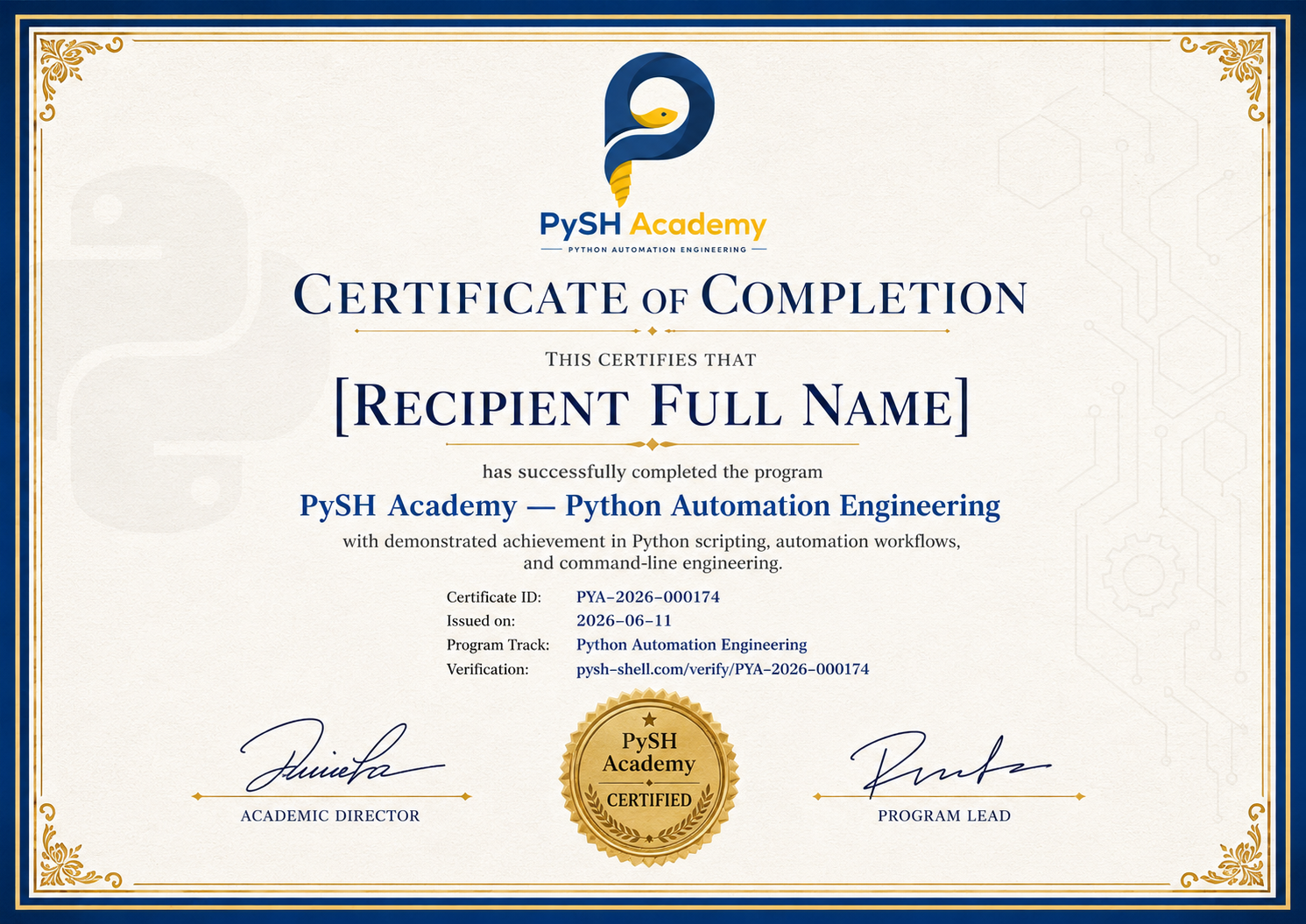
PySH Academy certification programs are planned as the specialization curriculum expands. CS-PY-001 is the current public foundation course on Cartesian School; advanced PySH Academy tracks will be added progressively.
Join the Community
Connect with students and automation engineers on Telegram.
PySH Academy
Scan the code above or use the Community page to join the PySH Academy Telegram community.